This Post Discusses The LASIK Alternatives For Thin Corneas


Posted by-Nyholm McNeil
There are many individuals who have actually been told they can't receive LASIK eye surgery due to poor corneal thickness. Thankfully, there are other refractive surgical treatment choices for them to consider.
These new therapy options are a lot more effective than LASIK at treating certain sorts of vision troubles as well as minimizing the demand for glasses or contacts. They're also a lot more economical than LASIK!
1. PRK
LASIK is a popular laser vision modification surgery, but not everyone is a perfect candidate for it. https://telegra.ph/What-Are-The-Benefits-Of-Lasik-Eye-Surgical-Treatment-04-14-3 is especially true for those with thin corneas or those that participate in active sports or work in high-risk work that place them at a higher danger of injury to their eyes.
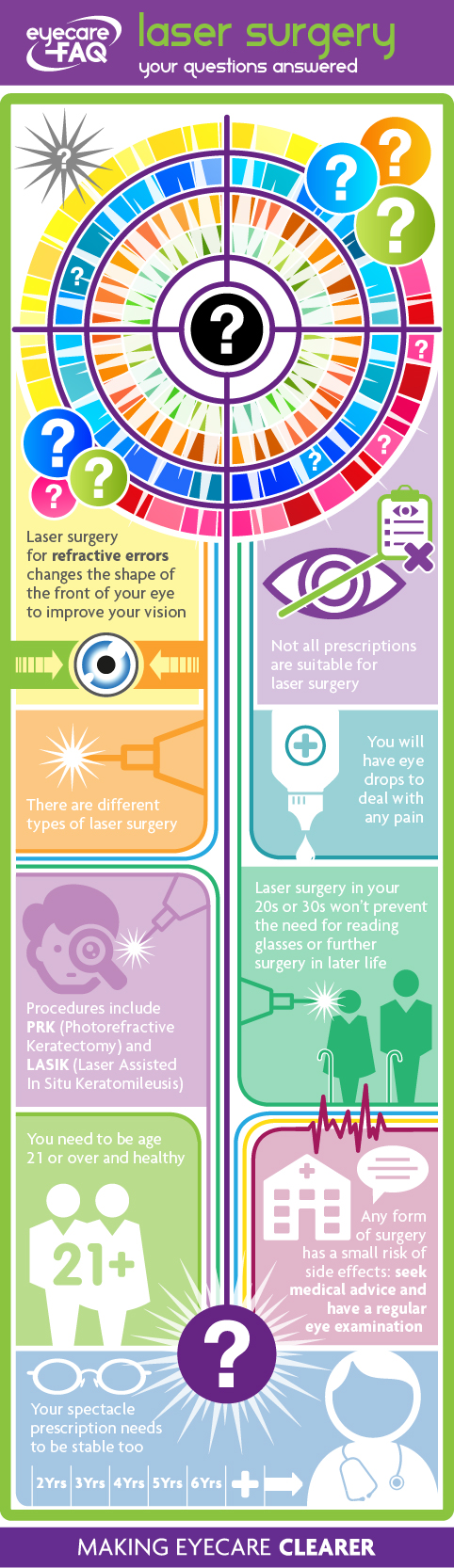
The good news is, there are various other lasik alternatives that are effective as well as risk-free for individuals that don't receive LASIK. Among these is PRK (photorefractive keratectomy).
Like LASIK, this treatment aims to completely remedy your refractive error. It also allows you to lower or get rid of the demand for glasses and contacts.
2. ASA
If you're thinking about LASIK but have completely dry eyes or slim corneas, ASA (Advanced Surface area Ablation) might be the appropriate alternative for you. This laser vision modification strategy reshapes the outer layer of your cornea, allowing your cosmetic surgeon to make use of an excimer laser to correct your eye's refractive mistake.
ASA is a more advanced variation of PRK, or photorefractive keratectomy, which was the precursor to LASIK as well as was first authorized by the FDA in 1995. Throughout this treatment, your epithelium is separated, moistened with a watered down alcohol remedy, as well as folded up back, before the excimer laser reshapes the cornea.
ASA has fewer dangers than LASIK or PRK, as well as it typically takes a shorter healing period. However, there are some side effects that ASA individuals could experience, including post-operative discomfort and pain, undercorrection or overcorrection, as well as night vision disturbances.
3. Refractive lens exchange
For patients who are drastically myopic or farsighted and also can not undergo laser vision modification procedures like LASIK or PRK, refractive lens exchange is a great choice. This procedure is done by replacing your all-natural lens with a special intraocular lens (IOL) that corrects your refractive error and gets rid of the demand for glasses or contacts.
If you deal with presbyopia, an age-related eye problem that creates you to have difficulty seeing at close ranges, Refractive lens exchange is the very best alternative offered to you. This is due to the fact that LASIK can not effectively fix this eye trouble as it works with the cornea.
For most people, the aging process creates the lenses in their eyes to lose flexibility as well as become less flexible. https://squareblogs.net/lyle174dewitt/what-are-the-advantages-of-lasik-eye-surgical-procedure creates troubles focusing on up close objects such as reading and also dialing phones.
4. Monovision
Monovision is an approach of vision modification that utilizes a call lens to correct for both far and wide distances. It is most frequently made use of to deal with presbyopia, which is a typical eye problem that occurs as people age.
It can likewise be an option to LASIK in some people. With related web site , one eye is corrected for distance vision as well as the various other is dealt with for close-up vision (near vision).
Lots of people who utilize monovision get in touch with lenses do not need reviewing glasses or glasses. However, this is not always the instance.
In a small number of situations, it can be needed to put on glasses when working with fine information or focusing on close-up items.
Surgical choices for monovision include laser surgical treatment as well as intraocular lens insertion. In the short term, monovision might be attempted with contact lenses to determine if it is appropriate for a patient.